
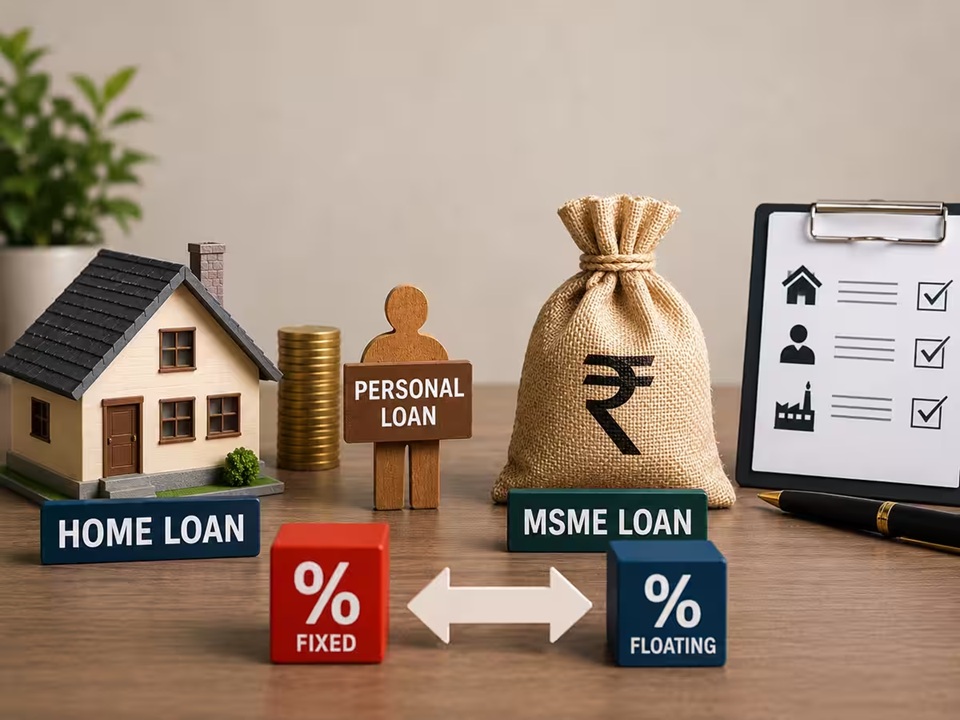
On 7 October 2026, the Reserve Bank of India (RBI) increased the repo rate by 25 basis points (bps) to 5.50 per cent, the first rate hike in nearly three years. For many Home Loan borrowers and potential applicants, the immediate question is: should I keep floating, fix my home loan, or do nothing? The answer depends on several factors.
However, it is important to understand how the latest rate change impacts you and what your best course of action.
What Changed as per the Latest Rate Change?
A change in the policy rate does not uniformly affect everyone and everything. There are also various factors that need to be taken into account.
- Impact on Floating Rates & Loans:
If you have a floating rate, your bank or NBFC will increase your rate as per your floating rate resetting cycle. This either translates into a higher EMI amount or a longer tenure if you choose not to revise the instalment.
- Impact on Fixed Rates & Loans:
A fixed interest rate loan remains fixed regardless of any hike or decrease in the official rate. That said, a lot depends on the time horizon of the fixed deposit in your contract.
Fixed vs Floating Rates – Pros & Cons
Both types of rates have their pros and cons.
- Floating Rates:
The flexibility in floating rates gives you the opportunity to benefit from the potential downtrends of the economy. However, for a borrower with a tight budget, it is a disadvantage to have to deal with unpredictable EMI cycles.
- Fixed Rates:
The fixed rates can initially appear to be quite expensive, particularly when a floating rate is present. In addition, a higher rate of prepayment on a fixed-rate loan is disadvantageous. That said, fixed rates guarantee consistency and reliability when it comes to payments for the tenure.
What Should an Active Home Loan Borrower Do?
As active home loan borrowers, there is definitely some action that you can take. Here we explore the options:
- Assess when your cycle is likely to reset and your EMI is likely to be increased. Find out from your lender whether a fixed or floating rate loan has a specific EMI hike cycle and an applicable average spread.
- Even a partial prepayment with the ability to adjust the extra amount borne on an increase in EMI will help reduce the total outstanding principal as well as interest at an important juncture when rate increases are in place.
- While most lenders prefer increasing the EMI when a floating rate is increased, some lenders have a tendency to extend the tenure, leading to higher overall interest being paid. As far as possible, it is a good idea to maintain the tenure with only a slight increase in EMI.
- It is always important to remember that processing fees, as well as other expenses, are also involved when switching a loan. A calculation of the net benefit to be derived from switching a loan against the expenses will help one make an informed choice.
What Should Potential Home Loan Borrowers Do?
If you are a potential home loan applicant looking to take a loan in the next few months or years, here are a few guidelines.
- Assess your own budget:
If you have the flexibility to withstand a slightly higher EMI, you can go in for a floating rate. If not, you may need to consider a fixed or a fixed-to-floating rate loan.
- Time you plan to prepay or not:
Floating rate loans generally give the opportunity to the borrower to plan their payments more appropriately – particularly when taking into account any possibility of prepayment or foreclosure.
- Review part-prepayment and foreclosure charges:
These charges can have a huge impact on the overall cost of a loan. Ask your lender or read your loan document to know which of these charges are applicable to part-prepayment or foreclosure under the fixed and floating rate.
How Can the Insurance App Help You Take Control of Your Home Loan Situation?
Everything looks much less daunting if someone has the numbers in front of them, enabling them to compare and contrast, and make more accurate calculations.
- Compare Rates:
It is important to assess the affordability and value of a particular rate, amount and tenure. The EMI calculator can help you test different numbers. Try using this calculator to understand what a 0.5 increase in rate will do to your EMI, and your budget.
- Flexible Options:
Home Loan gives you an option to choose between fixed and floating rates of interest. You can apply for a loan with a tenure of 15 to 30 years, and 90% (subject to approval) of the value of the property can be financed.
- Part-prepayment & Foreclosure:
An individual on a floating rate has the option of making a part-prepayment without any extra charges. This gives the borrower an opportunity to reduce the EMI, which is particularly advantageous in a growing interest scenario.
- Manage Active Loan:
Having all your account activity in one app is very convenient. It helps one to stay on top of the EMI schedule as well as manage any changes resulting from a revision of the floating rate.
Conclusion
Floating rates reward flexibility, while fixed rates reward certainty. Regardless of which rate category you fall into, make sure to assess your reset cycle, test your EMI budget, and consider the impact of prepayments or pre-closure charges.
Bajaj Finance encourages you to adopt the right approach when making changes to your Home Loan. By offering both fixed and floating rate options, along with an EMI calculator on the Bajaj Finance app and no additional charges for prepayment or foreclosure for individual borrowers on floating rates, it helps you to ensure flexibility and manage your finances without putting too much strain on your wallet.