
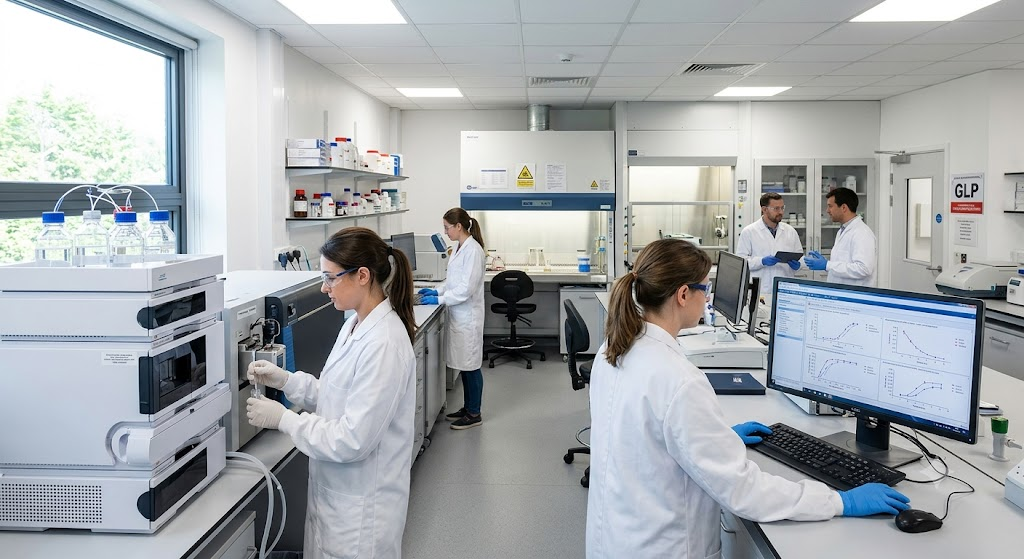
Somewhere between hit-to-lead and first-in-human dosing, every drug developer hits the same wall: you need a data package solid enough to survive regulatory scrutiny, and you probably don’t have the in-house infrastructure to generate it yourself. DMPK, safety pharmacology, in vivo efficacy — building all of that internally would take years and a lot of capital most biotechs don’t have lying around. So you find a partner. The question is which one, and why it matters more than people think.
Why de-risking early actually saves you money
The whole point of preclinical work is to kill bad candidates before they get expensive. Everyone in this industry has heard the phrase “fail fast and cheap,” and it’s a cliché for a reason — it’s true. The cost of finding out if a molecule doesn’t work climbs steeply once you’re in the clinic, which is why partnering with an experienced preclinical UK CRO to spot these problems early can make all the difference to your timeline and budget.
A good CRO helps you answer three questions that, frankly, determine whether your program survives: Does the molecule actually hit the target it’s supposed to, without causing collateral damage elsewhere? Does it get where it needs to go in the body, at concentrations that matter, for long enough to do something useful? And can animals — eventually humans — tolerate it at doses that produce a therapeutic effect? Get any of these wrong and you’ll find out in phase 1, which is a far more expensive place to learn a hard lesson.
The pillars, and why they’re interconnected (not separate boxes)
It’s tempting to treat ADME, DMPK, pharmacology, and toxicology as four checkboxes on a project plan. In practice they bleed into each other constantly, and the CROs that do this well tend to treat them that way too.
Testing of ADME in vitro, like plasma protein binding, CYP inhibition, permeability and the like, gives you an indication of whether or not your molecule will behave in a proper manner metabolically. Then comes the in vivo DMPK, with Cmax, Tmax, AUC, half-life and tissue distribution, among other things. With advances in high sensitivity LC-MS/MS systems, this is done much more accurately than before. This is very important especially for any agent that targets inaccessible compartments like CNS.
On the pharmacology side, translational fidelity is everything. A dose-response curve that looks beautiful in a poorly chosen animal model tells you almost nothing about what will happen in a human trial. What often gets overlooked here is unbound drug concentration at the target site — not plasma levels, the actual free concentration where the drug needs to act. Microdialysis and modern neuro-imaging can measure this directly now, and in our experience it’s one of the better predictors of whether a CNS program is going to translate.
Toxicology, of course, is where GLP compliance becomes non-negotiable. Dose-range finding, cardiovascular and CNS safety pharmacology, full GLP tox studies — regulators expect rigor here, and rightly so, since this is the data that determines whether you’re allowed to dose a human being at all.
Why outsource this instead of building it yourself?
A few reasons come up again and again when we talk to sponsors.
First, there’s the obvious one: building animal facilities, containment suites, and analytical equipment from scratch is enormously capital-intensive, and most of that infrastructure sits idle a good portion of the time. Second, an established CRO already operates under GLP, GCP, and AAALAC frameworks, which means your data has a much easier time surviving an audit later — you’re not building compliance from zero. Third, and this one gets underrated, a CRO with flexible scheduling and a dedicated study director can often move faster than an internal team juggling five other priorities. Months faster, sometimes.
And then there’s expertise. Complex assay design, matrix-matched bioanalysis, disease models that took years to validate — that knowledge lives in the heads of scientists who’ve been doing this for a decade or more. You’re not just renting lab space; you’re renting judgment.
So how do you actually pick one?
Track record is the obvious starting point — has this CRO supported programs that made it to IND or CTA, ideally in your therapeutic area? Get into more specifics such as the institution’s MHRA, FDA, GLP, and AAALAC certification. They are not just formalities but the basis of having your results accepted or questioned.
Communication matters more than people give it credit for. Is this CRO going to function like an extension of your team, flagging problems as they arise, or are you going to get a report at the end and nothing in between?
Finally, look for integration. A CRO that can carry a program from in vitro ADME screening straight through to in vivo efficacy and GLP toxicology, without handing you off between vendors at every stage, tends to keep programs moving. Partnering with a reliable preclinical UK CRO that understands the science as well as the regulatory bar, and who tells you the truth when something looks off, makes the path considerably less painful.